Translated automatically from Indonesian.
In every farming activity, the various tools used have their own stories and functions in working the land. And in Tegalsiwalan Village, Tegalsiwalan District, Probolinggo Regency, there is local knowledge passed down from generation to generation and still preserved today. In a field visit we made to one of the shallot farmers in Tegalsiwalan Village, we were introduced to […]
In every farming activity, the various tools used have their own stories and functions in working the land. And in Tegalsiwalan Village, Tegalsiwalan District, Probolinggo Regency, there is local knowledge passed down from generation to generation and still preserved today.
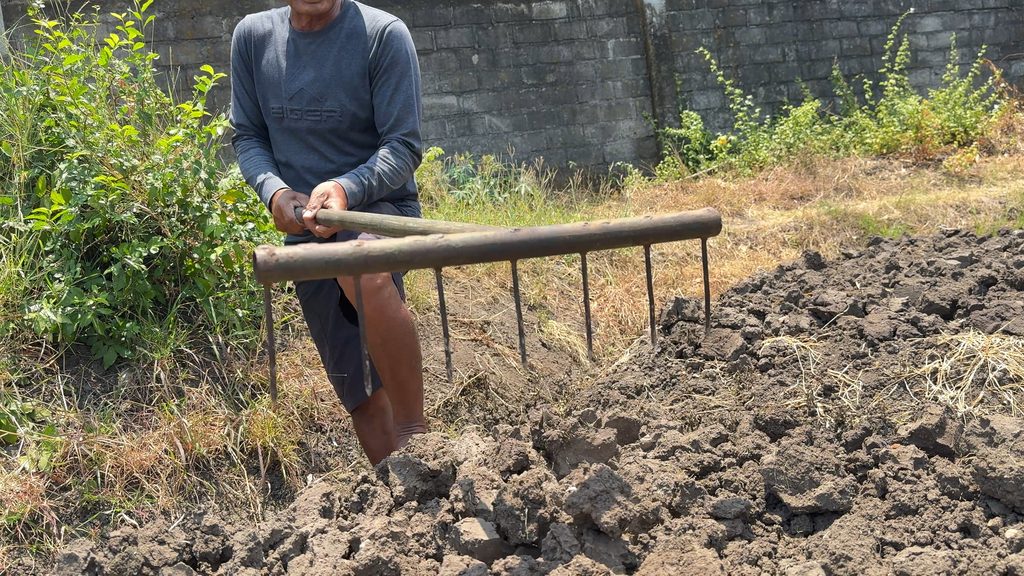
In a field visit we made to one of the shallot farmers in Tegalsiwalan Village, we were introduced to various tools used in shallot cultivation. Starting with traditional tools, namely ‘Cedok’, a shovel-shaped tool used to make water channels, then ‘Garuk’, shaped like a small fork, which functions to level the soil before planting, to ‘Penggaris’, shaped like a large fork, used to determine planting spacing or planting holes.
According to local farmers, the skill in using traditional tools in shallot cultivation has been passed down from generation to generation. However, over time, farmers began to use modern technology to make farming work easier. One of them is the ‘Cultivator’, a soil-processing machine that helps reduce labor needs. In addition, modern sprayers are also used
to make it easier to spray pesticides that are useful for controlling pests that disturb plants.
Changes have not only occurred in farming equipment, but also in the management of agricultural information. Some young farmers now use digital technology to manage agricultural information so that it is more widely known by the outside community, record production costs, cultivation activities, and harvest results.
At the end of the conversation, one of the farmers conveyed a simple message to the younger generation, “The young are the ones who create. Awesome!”
The story shared by one of the shallot farmers in Tegalsiwalan Village is a reminder for all of us that agricultural progress does not have to leave behind traditional knowledge. Both can go hand in hand, preserving local heritage while opening opportunities for innovation for the younger generation for the future of agriculture.